

A developer we spoke with last year had just closed out a campaign that, on paper, looked excellent. Four hundred and twelve leads in six weeks. Cost per lead under two hundred rupees. The agency’s report had a green tick against every KPI they’d set.
The sales team had converted three of those leads into site visits. Zero bookings.
This is not a rare story. It is close to the default outcome when a property developer hires a generalist digital marketing agency and lets it run a real estate account the way it would run one for a clothing brand or a food delivery app. The agency did exactly what it was told to optimise for — cheap leads — and delivered precisely that. The problem was never the execution. It was the brief. Hiring a real estate digital marketing agency in Kolkata that understands how property actually sells — rather than a generalist applying an e-commerce playbook — is the difference between four hundred leads and four bookings.

Why Generalist Agencies Fail Property Developers
Most digital marketing agencies are built around a playbook that works well for transactional categories: get someone to click, get someone to fill a form, count the form fills, report the cost per form fill, repeat. It’s a sound model when the product costs a few hundred or a few thousand rupees and the buying decision takes minutes.
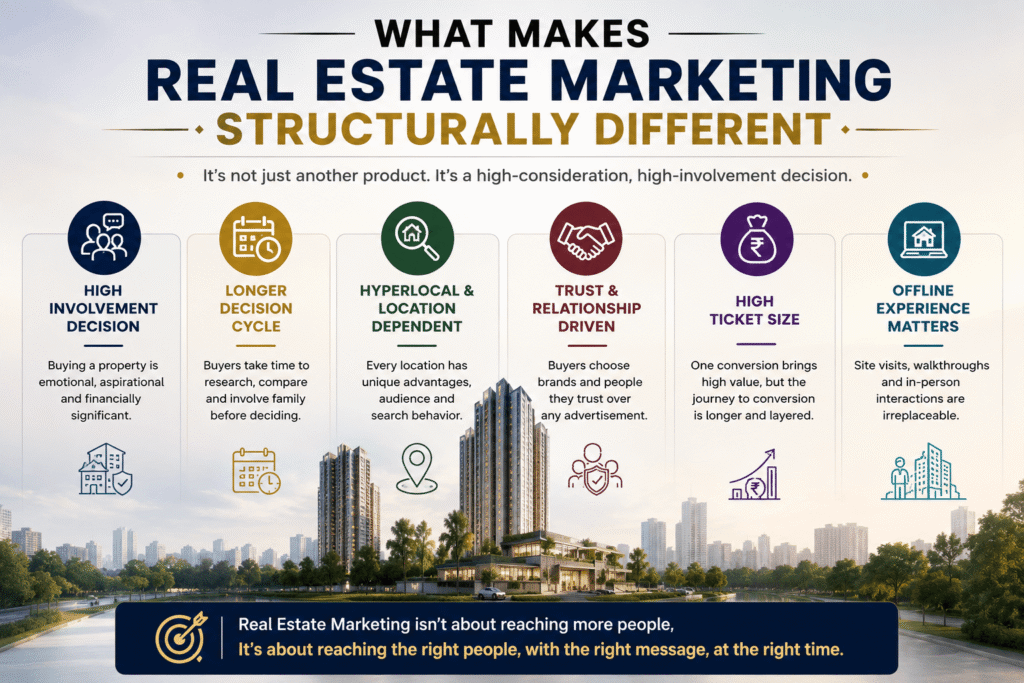
A residential apartment in Kolkata is not that product. The decision often takes six to eighteen months. It involves a spouse, sometimes parents, occasionally a financial advisor. It is very often the single largest purchase a family will make in a decade. Running that buyer through a “fill this form for a free brochure” funnel and measuring success by form-fill volume produces exactly what it produced for the developer above: a pile of curious browsers, price-shoppers, and brokers harvesting leads to resell, none of whom were ever going to book a unit from a generic campaign.
A real estate digital marketing agency in Kolkata that actually understands the category builds the entire funnel around a different question: not “how do we get the cheapest lead,” but “how do we get the right family to walk into the sales office.”
What Makes Real Estate Marketing Structurally Different
Consideration Cycles of Six to Eighteen Months
Nobody buys an apartment the way they buy a pair of shoes. A family might see your project ad in March, research competing projects through the monsoon, take a site visit in September, negotiate through Diwali, and sign in January. Any campaign measured on a 30-day attribution window is blind to almost the entire journey. Marketing built for real estate has to plan for nurture sequences that run for the better part of a year, not a sprint that ends when the ad budget for the month runs out.
The Site Visit Is the Real Conversion, Not the Form Fill
A form fill costs nothing and commits nobody. A site visit costs the buyer an afternoon, a drive, and often a conversation with a spouse about whether this is even worth exploring further. That is the point at which intent becomes real. Any real estate campaign that reports success in form fills rather than scheduled and completed site visits is reporting the wrong number, and everyone on the sales team already knows it.
Ticket Values That Change the Economics of Everything
A ₹1.5 crore apartment can justify a cost per qualified lead that would be absurd for almost any other product category. This changes what “efficient” spending looks like. An agency applying e-commerce-style CPL targets to a real estate account is often walking away from profitable spend because the number looks high in isolation, without ever asking what a single closed sale is worth. Our guide to what a digital marketing agency costs in Kolkata breaks down how developer budgets differ from other categories.
Broker Interference in Paid Lead Flow
Property brokers routinely fill out developer lead forms using client details, or their own, to harvest project information and reach out independently — sometimes to compete directly against the developer’s own sales team for the same commission. A campaign with no qualifying logic in the form will accumulate broker noise at a rate that can exceed 30% of total volume, quietly wrecking every downstream conversion metric.
Multi-Stakeholder Buying Decisions
The person who clicks the ad is frequently not the person who makes the decision. Campaigns and creative that speak only to one decision-maker — usually the primary earner — miss the spouse, the parent contributing to the down payment, or the sibling who will actually live nearby and has an opinion about the neighbourhood.
The Metric That Should Replace Cost Per Lead
If there is one change a developer should make to how their marketing gets evaluated, it is this: stop reporting cost per lead as the headline number and start reporting cost per qualified site visit.
A qualified site visit is one where the visitor meets a minimum bar you define upfront — typically a verified phone number, a stated budget range that matches the project, and confirmation that the visitor is the actual decision-maker or accompanied by one. Instrumenting this requires your CRM and your ad platforms to talk to each other: leads get scored and tagged the moment the sales team makes contact, and that tag (qualified, unqualified, broker, wrong budget) should route back into your ad platform as a conversion signal.
Once that loop exists, the ad platform’s algorithm starts optimising toward people who resemble your actual qualified visitors — not toward people who resemble anyone willing to type a phone number into a form. This single change typically does more to improve real estate campaign quality than any amount of creative testing. We cover the mechanics in detail in our Kolkata real estate lead generation playbook.
The Channel Stack That Works for Kolkata Developers
Search
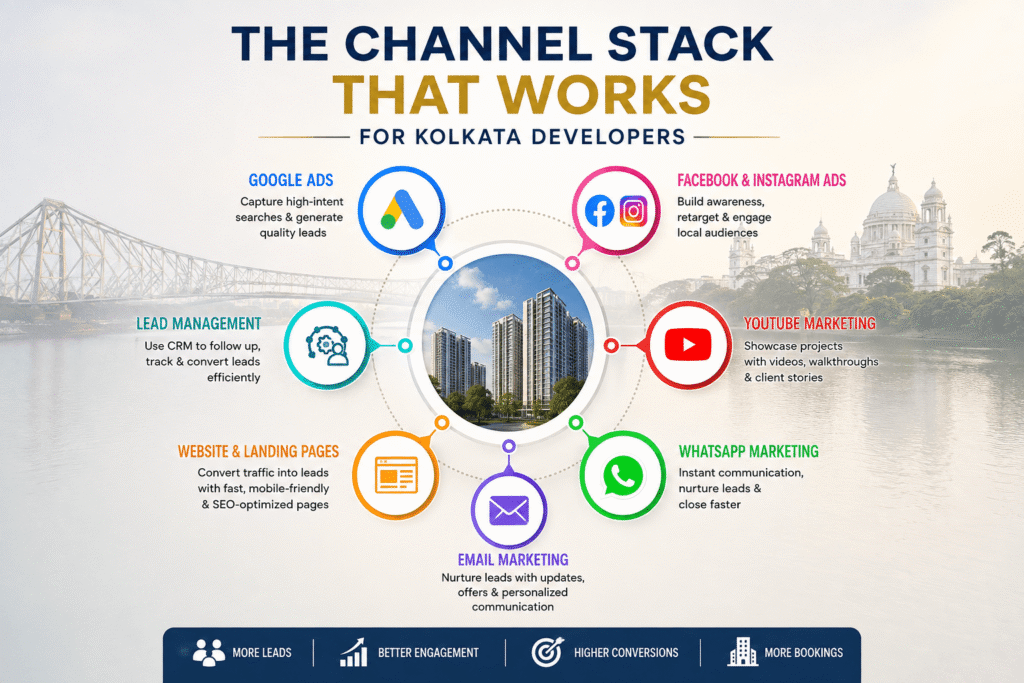
Search captures existing demand rather than creating it. Someone typing “3BHK flats in New Town under 80 lakhs” has already decided to buy in that locality and price band — they are asking Google to shortlist them a project. These are expensive clicks, and they are worth it, because the intent is already formed. This is the core of how we structure Google Ads for real estate.
Meta
Meta’s strength is precision targeting built on lookalike audiences drawn from your actual buyer data — not just interest categories, but people who resemble the families who have already booked units with you. Visual storytelling matters enormously here; a well-shot carousel of a show flat will consistently outperform a static price banner. See our approach to real estate social media marketing and Meta ads.
YouTube
Project walkthrough videos meaningfully shorten the gap between “interested” and “willing to book a site visit.” A five-minute video that lets a prospective buyer mentally walk the corridors, see the balcony view, and understand the layout does work that no amount of copy can replicate — and it pre-qualifies visitors before they ever contact your sales team.
This is the highest-converting follow-up channel in the Indian real estate market, and it remains underused by most developers. A WhatsApp sequence that sends a floor plan, a construction update video, and a personal message from the sales manager will out-convert an email nurture sequence by a wide margin.
Local SEO and Project Microsites
A dedicated microsite for each project — rather than a subpage buried inside your corporate website — lets you match ad messaging precisely, build locality-specific content, and track that project’s funnel in complete isolation from every other project you’re running. We build these as part of our real estate website development work, paired with local SEO in Kolkata so the project surfaces for locality searches too.
Influencer and Channel Partner Amplification
Local lifestyle and real estate content creators, along with established channel partner networks, extend reach into audiences that distrust direct advertising but will act on a recommendation from someone they already follow. Our influencer marketing for real estate programmes are built around tracked outcomes rather than follower counts.
Lead Routing and CRM: Where Most Campaigns Actually Break
Even a well-targeted campaign fails if the lead sits in an inbox for four hours before anyone calls. Contact rates fall sharply after the first hour and keep falling. The fix is entirely operational, not creative: instant lead routing to an available sales executive, a defined response SLA (five minutes is the standard worth aiming for), lead scoring that flags likely brokers before a human wastes time on the call, and — critically — feeding the outcome of every closed or lost lead back into your ad platforms so the algorithm learns what a real buyer actually looks like. This is the backbone of our real estate lead generation service.
What to Ask a Real Estate Marketing Agency
How do you define a qualified lead for a project like mine? If the answer is generic — “someone who fills the form” — that is not a real estate marketing agency, whatever the pitch deck says.
How do you filter broker enquiries out of paid campaigns? This should have a specific, mechanical answer involving form logic, lead scoring, or both.
What is your process for a launch versus a sustenance campaign? These are different jobs requiring different budget allocation and creative. An agency that runs the same playbook regardless of project stage hasn’t thought about this.
Can you show cost per site visit from a previous project? Cost per lead is easy to make look good. Cost per site visit is much harder to fake, and asking for it filters out agencies that haven’t actually built the qualification layer. If you are comparing options, our page on real estate marketing companies in Kolkata sets out the same questions from the buyer’s side.
What Real Estate Digital Marketing Costs in Kolkata
Launch campaigns — the intensive period around a project’s public announcement — typically require agency fees starting from ₹1,50,000 monthly, with media spend budgeted as a percentage of projected project revenue rather than a flat number, since the scale of a launch varies enormously with project size. Sustenance campaigns, run once initial momentum has been established, generally settle into a lower monthly retainer with a steadier, lower media spend focused on maintaining visibility and feeding the ongoing sales pipeline. Luxury and HNI projects sit at the higher end of every range, both because the creative and channel requirements are more specialised and because the cost of an unqualified lead pool is proportionally more damaging to a premium brand — we cover that segment separately in our guide to luxury real estate marketing in Kolkata.

Before You Shortlist
If you are still comparing options, our guides to full-service versus specialist agencies and the red flags worth checking first are both worth a read.
Why Rule of Growth
We are a real estate digital marketing agency — not a generalist firm that happens to also take property clients. Our head office is in Kolkata, we have a second office in Bangalore, and we work across the Dubai market for developers with an NRI-facing launch. Every account we run is reported against cost per qualified site visit, not cost per lead, because that is the number that actually correlates with bookings. If your business isn’t real estate, we’ll tell you directly and point you elsewhere — we’d rather do one thing well than take a retainer we can’t add real value to.
Talk to our team about your project and we’ll send a costed campaign plan within one working day.
Frequently Asked Questions
Why do real estate developers need a specialist marketing agency?
Property has consideration cycles of six to eighteen months and converts on site visits rather than form fills. Generalist agencies optimise for cheap leads, which produces high volume and low booking rates.
What is a good cost per lead for real estate in Kolkata?
Cost per lead is the wrong target. Cost per qualified site visit is the metric that correlates with bookings, because a cheap lead that never visits the site has no commercial value.
How do you stop brokers from filling up paid lead forms?
Through qualifying questions in the form, audience exclusions, budget-qualifying creative, and lead scoring rules that flag broker patterns before the enquiry reaches your sales team.
How much should a developer spend on marketing a project launch?
Launch campaigns typically require agency fees from ₹1,50,000 monthly upward, with media spend set as a percentage of projected project revenue. Scale, location and price band drive the range significantly.