

Why This Matters More Than the Pitch Deck
Six months with the wrong agency doesn’t just cost the retainer. It costs the ad spend that went nowhere, the six months of runway a competitor spent building a real advantage while you were producing polished-looking reports, and the internal trust that erodes when a business owner has to explain to their team why the marketing investment produced nothing. Knowing how to hire a digital marketing agency in Kolkata is mostly a matter of knowing what to look at, and the pitch deck rarely reveals any of it. The account structure, the contract terms and a handful of direct questions usually do.
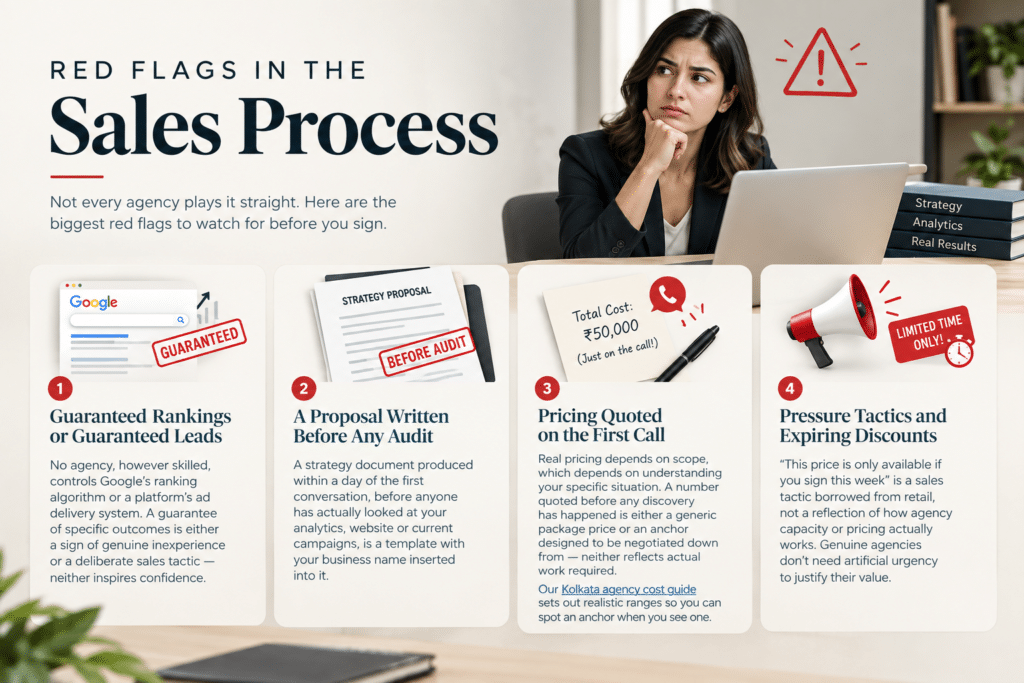
Red Flags in the Sales Process
1. Guaranteed Rankings or Guaranteed Leads
No agency, however skilled, controls Google’s ranking algorithm or a platform’s ad delivery system. A guarantee of specific outcomes is either a sign of genuine inexperience or a deliberate sales tactic — neither inspires confidence.
2. A Proposal Written Before Any Audit
A strategy document produced within a day of the first conversation, before anyone has actually looked at your analytics, website or current campaigns, is a template with your business name inserted into it.
3. Pricing Quoted on the First Call
Real pricing depends on scope, which depends on understanding your specific situation. A number quoted before any discovery has happened is either a generic package price or an anchor designed to be negotiated down from — neither reflects actual work required. Our Kolkata agency cost guide sets out realistic ranges so you can spot an anchor when you see one.
4. Pressure Tactics and Expiring Discounts
“This price is only available if you sign this week” is a sales tactic borrowed from retail, not a reflection of how agency capacity or pricing actually works. Genuine agencies don’t need artificial urgency to justify their value.
Red Flags in the Portfolio
5. No Named Clients
A case study describing “a leading real estate brand” without naming it is either protecting genuine confidentiality (rare, and usually explainable) or describing illustrative, not actual, work. Ask directly which is the case — ours are on our case studies and portfolio pages.
6. Results Without Baselines
“300% growth in leads” means nothing without knowing the starting number. Growing from two leads a month to eight is a very different story from growing from two hundred to eight hundred, and a credible agency will always provide the baseline alongside the improvement.
7. Awards You Cannot Verify
Many industry “awards” in the marketing space are pay-to-play placements rather than independently judged recognition. A quick search on the awarding body itself usually reveals which category it falls into.
Red Flags in the Contract
8. They Own Your Ad Accounts and Analytics
Your Google Ads account, Analytics property, and any other advertising or measurement infrastructure should be registered under your business, with the agency granted administrative access. Agencies that create and hold these accounts under their own ownership can hold your historical campaign data and learning hostage if the relationship ends.
9. Twelve-Month Lock-In With No Performance Break
A full year with no defined checkpoint to review performance and exit if things aren’t working heavily favours the agency. A reasonable contract includes a performance review clause, typically around the three-month mark.
10. Deliverables Written as Activities, Not Outcomes
“Twenty social media posts per month” is an activity. “Reduce cost per qualified lead by a defined percentage within a defined period” is an outcome. Contracts built entirely around activity counts let an agency technically fulfil every deliverable while producing no actual business result. How the fee itself is structured matters here too — see our breakdown of agency pricing models and the incentives they create.
Red Flags After You Sign
11. Reports Led by Impressions and Reach
If the first page of every monthly report is impressions, reach and follower counts rather than leads, cost per acquisition and pipeline contribution, the agency is reporting on what’s easy to make look good rather than what actually matters to your business.
12. The Senior Team Disappears After Month One
A common pattern: the pitch is delivered by an experienced, senior person, and once the contract is signed, day-to-day execution quietly shifts entirely to junior staff with minimal oversight. Ask explicitly, before signing, who will actually be working on the account week to week. This risk runs higher in high-turnover markets — worth reading alongside our guide to agencies in Salt Lake Sector V.
Seven Questions That Expose Most of These in One Call
Asking “what does your reporting actually look like — can I see a real, redacted example?” reveals whether metrics are outcome-focused or vanity-focused. Asking “who specifically will work on my account, and for how many hours a month?” surfaces the senior-pitch-junior-execution pattern before it happens. Asking “what would you deprioritise in my situation?” reveals whether real strategic thinking has occurred, since agencies without a real strategy tend to want to do everything. Asking “can you walk me through a campaign that didn’t work and what you changed?” tests honesty and depth more effectively than any success story could. Asking “who owns the ad accounts and analytics once we’re set up?” surfaces the ownership issue directly. Asking “what happens if I want to exit after three months?” reveals contract flexibility upfront. And asking “what’s the realistic timeline before I should expect meaningful results?” tests whether the agency is willing to set honest, unglamorous expectations rather than an inflated one designed purely to close the deal.
What a Good Agency Conversation Sounds Like
To balance the caution above: a credible first conversation usually involves more questions from the agency than promises. They ask about your sales process, your current numbers, your actual goals, and what’s already been tried. They’re willing to say “I’d need to look at your account before I could give you a real number” rather than quoting blind. And they talk about a realistic timeline that includes an honest early period where results are still being built, not promised.
Before you shortlist at all, it’s worth settling two prior questions: whether you need an agency or an in-house team, and whether a full-service or specialist agency fits your category better.
Put Us Through the Same Test
Ask us every question on this page. Get in touch and we’ll answer them directly — including who works on your account by name, what our reporting actually looks like, and what we’d deprioritise in your situation. You can see how we work as a digital marketing agency in Kolkata before you commit to anything.
Frequently Asked Questions
Can a digital marketing agency guarantee first-page rankings?
No. No agency controls Google’s ranking algorithm, and any guarantee of specific positions is either uninformed or dishonest. Credible agencies forecast ranges based on competition and domain strength instead.
Who should own my Google Ads and Analytics accounts?
You should, always. The agency gets administrative access to accounts registered under your business. Agencies that create accounts under their own ownership can hold your historical data and campaign learning hostage at exit.
What should a monthly agency report contain?
Leads generated, cost per acquisition, conversion rate by channel, and pipeline or revenue contribution. Impressions, reach and follower counts are supporting context, not headline metrics.
How long should a digital marketing contract be?
Six months is reasonable for work involving SEO or brand building, since results compound slowly. Insist on a performance review clause at month three and a defined exit process that transfers all assets to you.